
The Evolution of AI in the Automotive Industry: A 70 Year Journey from Theory to Practice
Explore how artificial intelligence has been used in the automotive industry for over 70 years, evolving from early research into modern applications across manufacturing, maintenance, and customer experience.
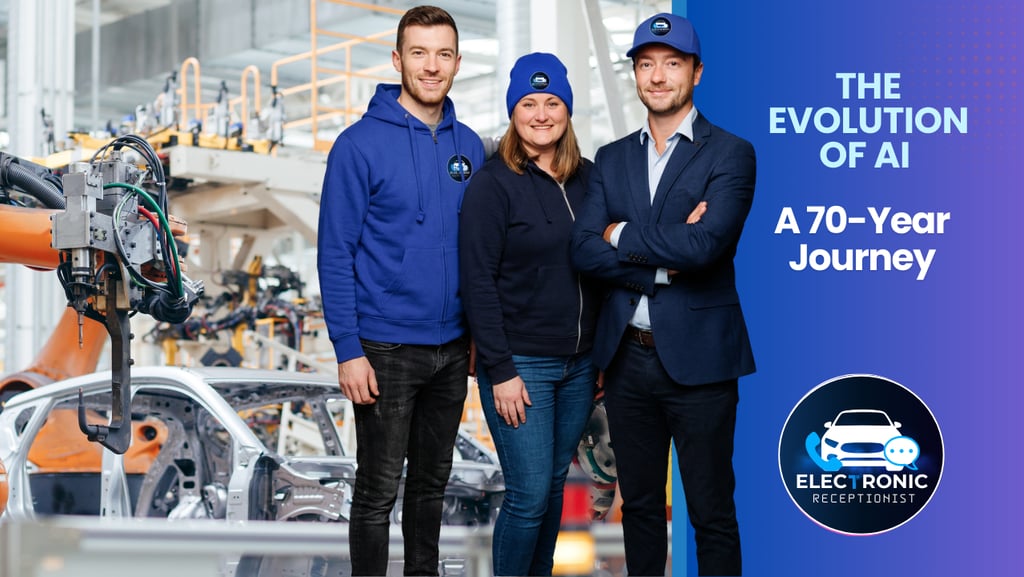
The Evolution of AI in the Automotive Industry
Artificial intelligence (AI) in the automotive industry is often seen as a recent innovation, driven by self-driving cars and modern automation. In reality, AI has been shaping the automotive sector for more than 70 years. What began as theoretical research in the 1950s has steadily evolved into practical, high-impact applications across manufacturing, vehicle design, logistics, maintenance, and customer communication.
From early experiments in machine reasoning to today’s AI-powered robots, predictive maintenance systems, and intelligent virtual assistants, automotive companies have long relied on AI to improve efficiency, accuracy, and decision-making. While the technology has matured dramatically in recent decades, AI’s role in the automotive industry is the result of continuous development — not an overnight breakthrough.
💡 1950s – The Big Idea
The concept of AI originated with pioneers like Alan Turing, who posed the question, “Can machines think?” His groundbreaking work laid the foundation for artificial intelligence in automotive research and beyond (csee.umbc.edu). By 1956, the Dartmouth Workshop officially coined the term "Artificial Intelligence," inspiring generations of researchers to explore machine intelligence across multiple industries, including the automotive sector. (Wikipedia)
🧪 1960s–1990s – Early AI Experiments
During this era, AI systems were limited to rule-based programming, simple game-playing, and basic translation (Britannica). While promising in theory, AI wasn’t yet ready to handle automotive manufacturing lines or supply chain challenges. Research labs focused on logic and reasoning, gradually laying the groundwork for real-world automotive applications in later decades.
💻 2000s – Computers Catch Up
By the 2000s, improvements in computing power, access to larger datasets, and more advanced algorithms enabled AI to move from research into practical use in automotive manufacturing and operations. AI began enhancing production workflows by analysing sensor data for quality control, optimising assembly processes, and enabling predictive maintenance that flagged equipment issues before breakdowns. Smart robotics and machine vision systems improved efficiency, helping factories reduce downtime, increase accuracy, and support complex decision-making in real-time. (Shadhin Lab: AI in Automotive Manufacturing).
🚀 2010s–Today – AI Gets Street Cred
Modern AI in the automotive industry goes far beyond manufacturing. Today’s systems analyse complex data, make intelligent decisions, and manage operations across production, logistics, and vehicle maintenance (IBM, S&P Global, Idea Usher). Automotive companies use AI to:
Monitor production lines and optimise logistics
Predict vehicle maintenance before failures occur
Handle customer enquiries and service requests with virtual assistants
Free engineers and managers to focus on innovation
Beyond vehicles and production lines, electronic receptionists and AI virtual assistants now manage calls and service enquiries instantly, reducing wait times and allowing human staff to focus on complex tasks — a clear demonstration of AI’s practical impact across automotive operations.
😲 The AI We Use Every Day (Without Even Realising)
Most of us interact with AI dozens of times each day without noticing, from smartphones recognising faces, to apps predicting traffic, to virtual assistants answering queries. The same technologies are now built into modern vehicles: helping cars learn driver preferences, assist with navigation, personalise in-car experiences, predict maintenance needs, and manage customer service through AI-powered receptionists. Cars are no longer just machines; they are rolling AI platforms, quietly supporting us every mile of the journey.
🤖 Key Benefits of AI in the Automotive Industry
Efficiency: Streamlines manufacturing, production, and logistics processes
Predictive Maintenance: Reduces downtime and vehicle failures
Customer Experience: AI virtual assistants improve response time and satisfaction
Innovation: Automates repetitive tasks, freeing human talent for strategic work
🔑 Artificial intelligence in the automotive industry
Artificial intelligence in the automotive industry has grown from theoretical experiments to an indispensable tool. From factory robots to AI-powered virtual assistants, the industry is leveraging AI to build smarter vehicles, operate factories more efficiently, and create better experiences for customers. AI isn’t new; it’s finally delivering real value to automotive businesses.
You might also like:
AI for Good: How the Best AI Is Helping Garages Grow, Not Replace Them
👉Back To AI Automotive Learning Hub
© 2025 Electronic Receptionist – All rights reserved.
Automotive Answering & Booking System for UK Garages.
UK Built | Built for Garages & The Automotive Industry | 24/7 Call Handling | Miss Fewer Bookings | Free Trial Available