
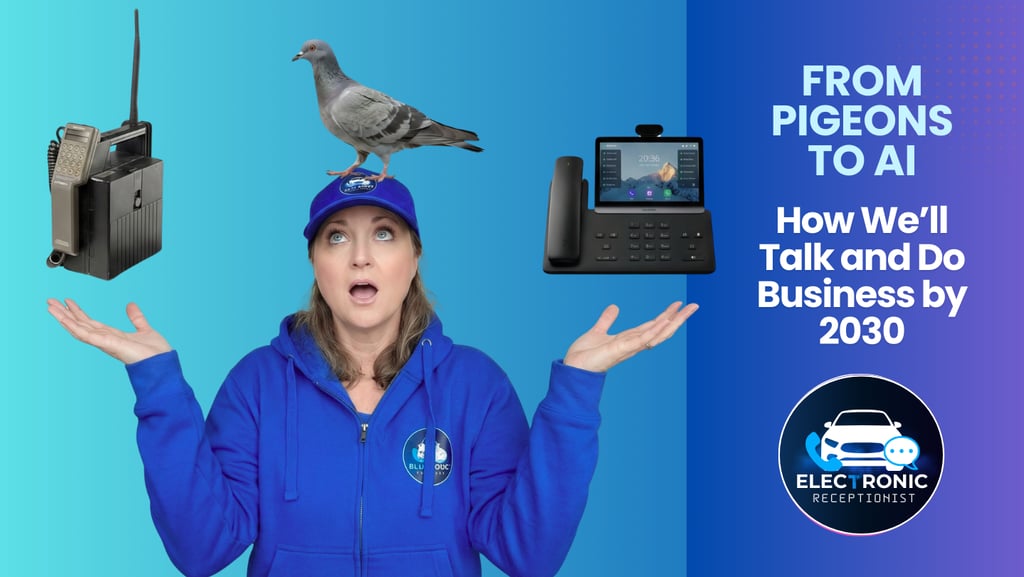
From Pigeons to AI: How We’ll Talk and Do Business by 2030
A funny, heartfelt look at how communication has evolved — from carrier pigeons 🐦 and brick phones to texts, video calls 📹, emojis 😅, and AI receptionists 🤖. What this change means for stressed business owners, especially garage pros who can’t afford to miss a single call — and how AI in automotive and automotive artificial intelligence are quietly shaping the future.
☎️ How Do You Like to Communicate?
Did you know Britain’s first official mobile phone call was made on 1 January 1985, just after midnight?
A young Michael Harrison rang his dad from a massive 5kg “transportable” brick phone in Parliament Square, launching the Vodafone network with a simple:
“Happy New Year, Dad." This is the first ever call on a UK mobile network.
Around that same era, my dad walked through the door with his version of the future.
I’m definitely giving my age away here, but I’ve always loved a proper phone call. Not a DM. Not “just WhatsApp me.” Not a voice note that needs three replays to understand. An actual phone that rings, with a real human voice on the other end.
My parents were very much face-to-face people. Phones were for emergencies. If they wanted a chat, they’d drive across town, knock on the door, and stay for tea, invited or not. You didn’t book visits back then. You just turned up.
Then one day my dad came home with the phone. That absolute brick — massive coiled handset, long antenna, weighed a ton, came with a briefcase. It was basically a portable car phone you could lug around if you were brave enough.
It cost a fortune, had no caller ID and no voicemail. If it rang, you answered. Full commitment.
Fast-forward to today, and communication feels like science fiction compared to that.
“The only constant in life is change.”
— Heraclitus, Greek philosopher (~500 BCE)
Everything flows, nothing stands still.
💡 Fact: the last official, sustained use of carrier pigeons to deliver messages ended in India… in 2008. Yes, 2008. A bird was delivering messages while we were already complaining about missed WhatsApp notifications! 🐦
👥 Generations Talk Differently & That’s Totally Fine
I grew up with phones like my dad’s, so I’ll probably always lean toward calling. Phones aren’t disappearing anytime soon, but as we head toward 2030, who knows what “normal” will even look like?
Recent surveys confirm what I’ve noticed: anyone under about 35 rarely answers a ringing phone. Communication now live in texts, apps, emojis, and quick video calls.
Over 70% of Gen Z and younger Millennials prefer texting over voice calls (source)
Many find phone calls anxiety inducing or simply too time consuming: 81% of millennials feel anxious before making a call, and 75% actively avoid them (source).
Nearly 70% of 18 to 34 year olds prefer text over phone calls (source).
That’s not a passing trend — that’s a shift. My own young daughter proves it daily: a normal phone call feels strange to her. Hand her the phone when Dad rings and she just stares at it, expecting to see him. But video calls with Nan? Completely natural. ❤️
Families aren’t always local anymore, and video bridges the distance. This is what communication looks like in real life now and this is exactly where AI in automotive and automotive artificial intelligence are quietly starting to play a role, even outside the factory floor.
🛠️ So What Does This Mean for Business?
For business owners, especially those in garages, this shift really matters. When you’re mid-job, hands covered in oil, a customer waiting, ramps full, and the phone rings again — you can’t always answer. Miss that call, and you might miss the job entirely.
WhatsApp is everywhere now. My uncle, who’s in his seventies, joins the family group chat, tries to call my brother, and somehow ends up video-calling six people at once. Total chaos. 😂
But WhatsApp isn’t actually free for businesses. Meta’s pricing changes effective 1 July 2025 moved to per-message charges for reminders, confirmations, and marketing messages. Customer-initiated chats stay free within a 24-hour window, but at scale, businesses are paying to play (source).
Tools evolve fast. Expectations rise. And the pressure lands squarely on the owner.
❤️ Why I Care About This
My dad was a business owner. Always stressed. Always on that brick phone or shouting into it. He passed away young, at 54, and that image has never left me.
My career has been about taking stress off owners like you — the proper ones who do everything, feel responsible for everything, and carry far too much. And the biggest stressor of all? The phone.
Missed calls mid-repair. Endless admin. Constant interruptions. Pure chaos. That overwhelm is very real, and most of us recognise it instantly.
🤖 How Communication Got Here & Where AI Fits In
Technology always barges in, disrupts everything, then quietly becomes normal. Machines freed skilled labour. Email reshaped offices. Instant communication became the default. But humans still can’t be everywhere at once.
That’s where artificial intelligence in cars and electronic receptionist come in, not to replace your team, but to support them.
Think of a never-tired, super-organised virtual receptionist that answers calls 24/7, handles common questions, routes calls properly, books appointments, captures leads, and actually sounds human when done right.
The intelligent virtual assistant market, which includes AI receptionists, is projected to grow from around USD 19.6 billion in 2025 to over USD 80.7 billion by 2030 (source).
Voice AI agents are expanding just as quickly, with multiple forecasts pointing to multi-billion-dollar growth by 2030 and beyond (source).
By the end of the decade, proactive and empathetic AI will manage full workflows, reducing burnout while preserving the personal touch customers still value. This is what friendly automotive artificial intelligence help looks like in practice.
🧰 From Dad’s Brick to Smart AI
If you’d told my dad, lugging that Telecom brick around, that one day a cloud-based AI would answer calls, book jobs, and take pressure off, he’d have laughed, told me to put the kettle on, and make him some toast.
Yet here we are. Communication keeps changing. The businesses that adapt don’t lose customers.
If phone stress is grinding you down in the garage, an electronic receptionist could change how your days feel, stop missed calls from becoming missed jobs, and let you focus on the work in front of you.
Give me a call — phone call preferred, although I’ll accept a WhatsApp voice note.
📝 Before You Scroll On
If communication has changed this much in one generation, it’s worth pausing for a moment and thinking about how you actually like to connect.
Ask yourself, or ask the people around you:
What’s your go-to way to talk with friends and family now? 📞💬📹
A proper phone call, a quick text, a voice note, video, or something else entirely?
How do you genuinely prefer businesses to contact you? By phone call, text, WhatsApp, email, app notification, or only when you reach out first?
Growing up, how did your parents or grandparents communicate? Landline calls, handwritten letters, surprise drop-ins?
How do your kids, or younger relatives, handle communication today? Do they answer a ringing phone, or live almost entirely in apps, messages, and emojis?
What’s the most frustrating way a business has tried to contact you recently, and why did it annoy you?
The answers are often more revealing than we expect — and they say a lot about where communication is heading next.
You might also like:
AI for Good: How the Best AI Is Helping Garages Grow, Not Replace Them

Ready to Take the Pressure Off Your Phone?
See how an Electronic Receptionist can answer every call, capture every lead, and let you focus on the work in front of you — without losing the human touch.
#SmallBusinessLife #CustomerExperience #AIinBusiness
© 2025 Electronic Receptionist – All rights reserved.
Automotive Answering & Booking System for UK Garages.
UK Built | Built for Garages & The Automotive Industry | 24/7 Call Handling | Miss Fewer Bookings | Free Trial Available